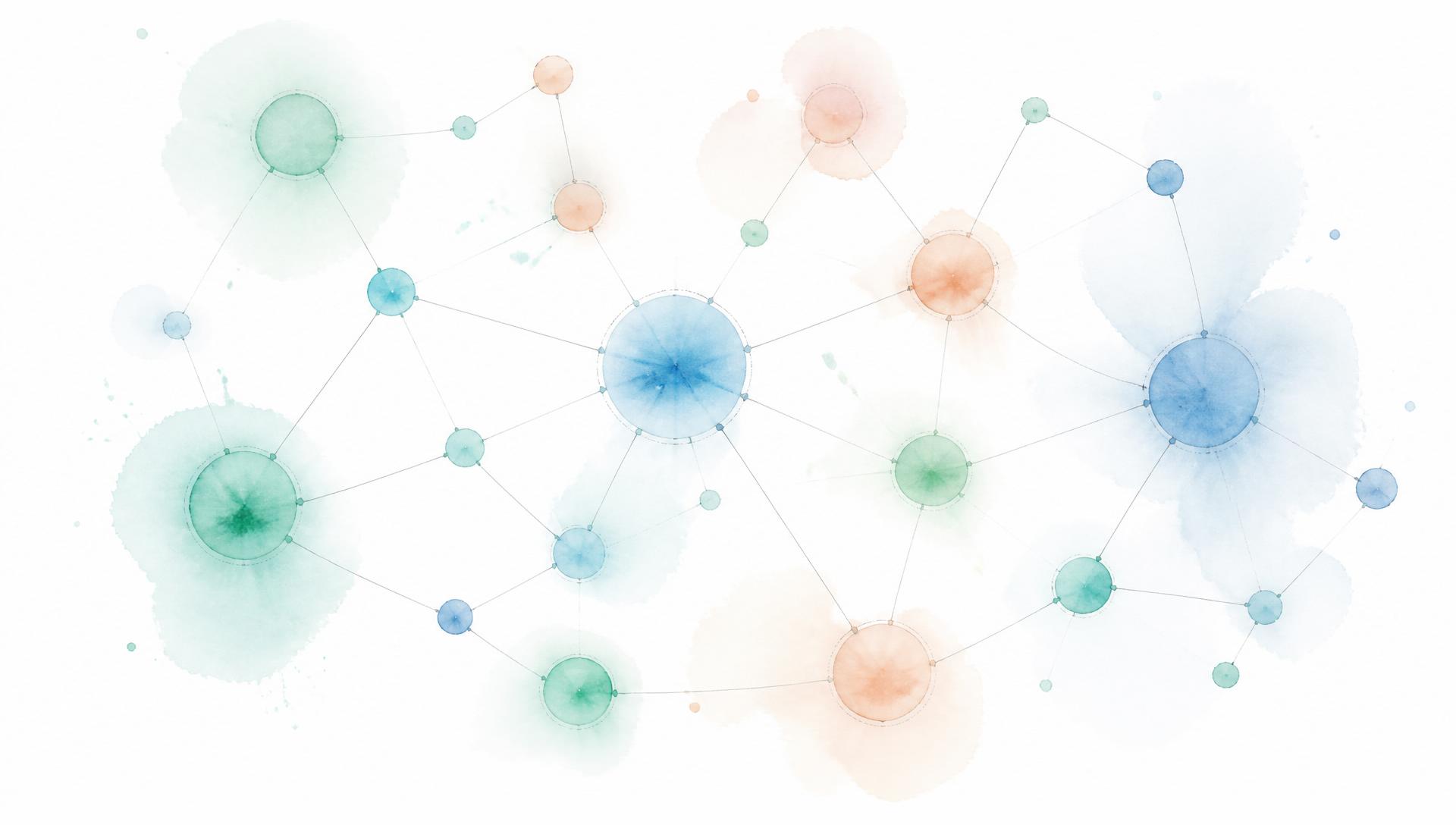
Ask ten AI leads what changed most in enterprise architecture between 2024 and 2026 and you will get the same answer. The winning deployments stopped treating retrieval as a search problem and started treating it as a graph problem. The knowledge graph, once the domain of librarians and ontologists, is now the load-bearing wall of every serious AI stack.
Why the graph moved to the centre
The first wave of enterprise AI ran on vector search. Chunk the documents, embed them, retrieve the top-k, hand them to the model. It worked for FAQ-shaped questions on well-scoped corpora. It broke on everything else.
The failure modes were consistent:
- Multi-hop questions. "Which customers on the enterprise plan have contracts expiring in Q1 who logged a critical ticket last quarter?" Vector search cannot join.
- Ambiguous entities. Three customers named Acme. Two products called Atlas. The model picks one and hopes.
- Permissions. The right answer for a manager is not the right answer for a contractor. Vector chunks carry no access model.
- Provenance. The model returns a confident answer. The user asks "where did that come from?" and the trail evaporates.
A knowledge graph fixes all four by design.
What a knowledge graph is - and is not
A knowledge graph is a structured model of your business:
- Nodes are the things that matter - customers, products, contracts, employees, systems, tickets, documents.
- Edges are the typed relationships between them - signed_by, reports_to, depends_on, expires_on.
- Properties hang off nodes and edges - dates, amounts, statuses, permissions.
It is not a database replacement. Your CRM, ERP, and warehouse stay where they are. The graph is a semantic layer above them that resolves identity, encodes relationships, and hands the AI a reliable map of your world.
The three-layer pattern winning in 2026
The architecture most enterprises are converging on:
Layer 1: sources of record
Salesforce, NetSuite, Snowflake, SharePoint, Jira, whatever you already run. No changes required.
Layer 2: the knowledge graph
A dedicated store - Neo4j, Stardog, TigerGraph, or Amazon Neptune - that ingests from the sources, resolves entities, and applies your ontology. Governance tools like Atlan or data.world sit here too, providing the catalogue, lineage, and access controls.
Layer 3: the AI surface
The model and its orchestration - LangGraph, LlamaIndex, or a custom stack. The model asks the graph for context, gets back typed entities with source URLs, composes an answer, and cites what it used. Vector search still lives here for semantic recall, but the graph is the source of truth.
What this unlocks
Real multi-hop reasoning
Microsoft's GraphRAG work demonstrated the pattern publicly: on questions that require joining three or four facts, graph-augmented retrieval outperforms vector-only by wide margins. In production, this shows up as executives finally getting reliable answers to the questions they actually ask - "which of our top ten accounts is at risk this quarter and why?" rather than "summarise this document."
Agents that can act
Agentic AI is only safe when the agent knows what it can touch. The graph is where you encode that. An agent asked to "reschedule the kickoff" needs to know who owns the calendar, who approves changes, and which contract clauses apply. All of that is graph structure.
Governance that survives audit
Every response carries the nodes it drew from and the edges it traversed. When a regulator or a customer asks "how did you arrive at that decision," you have a full trace. This is table stakes for the EU AI Act and increasingly for enterprise procurement.
How to start without boiling the ocean
The graveyard of enterprise data projects is full of ontology programmes that tried to model everything in year one. Do not do that. The pattern that works:
- Pick one high-value domain. Customers, or products, or contracts. Not all three.
- Model twelve entities and their key relationships. Not two hundred. Twelve.
- Wire two sources of record. Enough to prove entity resolution works. Add more once it does.
- Point one AI workflow at the graph. A sales-brief generator, a contract-risk summariser, a ticket-triage assistant. Ship it.
- Measure the delta. Answer accuracy, time saved, questions the old stack could not handle. Report to the board monthly.
Six to twelve weeks in you have a working slice. From there you extend the graph one domain at a time. This is how the winners are doing it.
The mistake to avoid
Treating the graph as a data engineering project. It is not. It is an AI process design project that happens to require a graph. If the modelling is not driven by the questions the business needs answered, you will build a beautiful ontology nobody uses.
Start from the executive question. Work backwards to the entities. Wire the sources. Then point the model at it. Every serious AI deployment in 2026 is doing exactly this, quietly. If you want a partner to design it with you, that is what we do.